1 Department of Applied Physics, Indian Institute of Information Technology Vadodara, Sector 28, Gandhinagar 382028, India 2 Centre for Quantum Science and Technology, Siksha ‘O’ Anusandhan University, Bhubaneswar, Odisha 751030, India 3 Department of Physical Sciences, Indian Institute of Science Education & Research (IISER) Kolkata, Mohanpur, Nadia 741 246, India
Abstract. Maxwell’s electrodynamics is a rich source of physical and mathematical ideas. Here we show how the displacement current, introduced by Maxwell, is related to mathematical discipline of topology.
Early on in the Physics courses like Electrodynamics and Fluid Mechanics, one learns about the conservation laws like law of conservation of energy, mass, electric charge, and so on. These conservation laws form the backbone of our present understanding of the working of nature. Here we shall focus our attention on electric charge conservation. The conservation law for electric charge is mathematically expressible as [1]:
Here stands for the electric charge density, whereas stands for the electric current density. The expression (1) can be better understood by imagining a small cube around point in space, and counting the number of charges inside it. Relation (1) says that if this number changes in time, then some charge must have been either moved out or brought in from the surface of the cube. Here the change in number of charges is captured by , while the in/out flow of charges is depicted by . This expression also dictates that if there is any charge creation then the sum total of positive and negative charges must be equal.
From the classic work of Emmy Noether, we now understand that the electric charge conservation is due to the existence of a phase freedom in the definition of the wavefunction. This means that under the substitution (for any real ), the Schrödinger equation and all its physical consequences are unaffected. Employing the Noether theorem, the charge conservation relation (1) follows [2, 3].
Suppose if one is given a function in three dimensions, then there is a well known identity involving operator:
If is a regular function of coordinates then this equation trivially holds, owing to the fact that the partial derivatives commute, for example:
However if has a profile of the form: ( is an integer) then the left hand side is non-zero in the above equation. This is because the value of at the origin is ill-defined, and in the vicinity it has a screw shaped surface. One might in fact evaluate the left hand side of (2) using Stokes theorem along any closed circuit C on the XY plane while enclosing the origin:
This quantity called vorticity essentially measures how tightly the is wound around the origin in screw like fashion. Such surfaces are generally referred to as multiply connected surfaces and more popularly as vortices. Vortices play a pivotal role in superconductivity, superfluidity and fluid dynamics. is also referred to as the topological charge [6].
A relation mathematically similar to (3) can also be written in the four dimensions. Let us consider that we are given electric field in some region. In most situations the electromagnetic fields are not infinitely large or vary discontinuously in time. So one can harmlessly write:
One observes that (5) and (1) have a striking similarity. If one defines density and current as:
then (5) acquires the form of a conservation law:
Since the origin of this conservation law is due to commuting of spatial derivative and temporal derivative , one says that the current conservation is of topological origin. The density can be thought of as the density of topological charge:
while is the current density due to the flow of the topological charge. Such topological charges/currents have attracted physicists from a long time, and they have been employed to explain physical phenomena like Berezinskii-Kosterlitz-Thouless phase transition and type-II BCS superconductivity [5, 6].
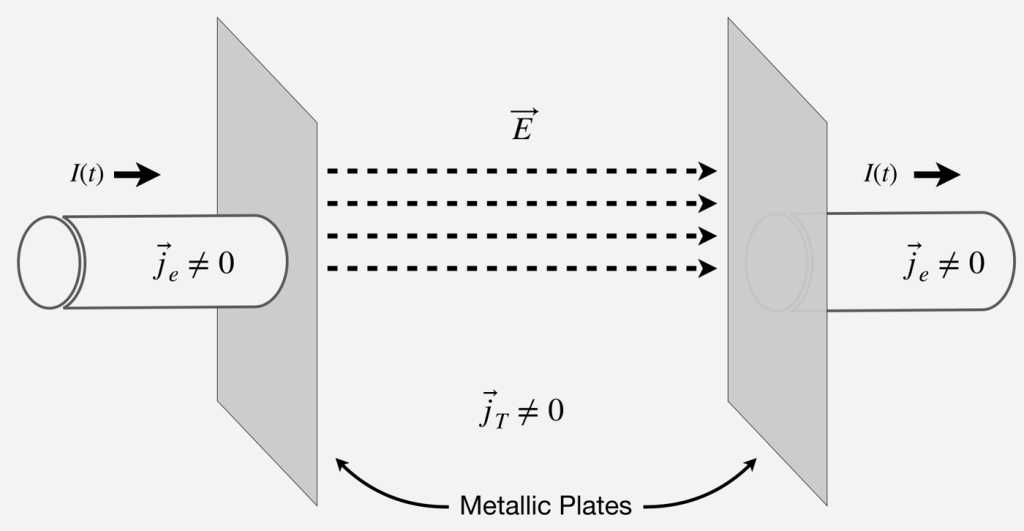
Figure 1. Schematic depiction of a parallel plate capacitor.
In the usual Electrodynamics course, one is not taught about the presence of the topological charge (8), and one might wonder if it gives any physical insights into the workings of Electrodynamics. Firstly let us note that topological current is actually negative of Maxwell’s displacement current . Secondly consider a parallel plate capacitor in vacuum (as depicted in Figure 1) wherein an electric current is made to flow through it. Since there are no electric charges/currents in the vacuum between the plates, one might want to ask how the current makes its way through the capacitor. Intuitively one might explain this effect by arguing that the flowing charges deposited on one of the plates generate electric field which influences the free electrons on the other plate, causing the charge movement, and hence a net current. This intuition can be quantified and refined by employing topological charge and current in the following manner.
The Gauss law (in Heaviside-Lorentz units) reads: , which essentially is a statement of equality of electric charge density and topological charge density:
In the light of (1) and (7), we have: . Now in the region outside the metallic plate . Whereas in the region inside the metallic plate, due to the presence of freely moving electrons, any electric field gets immediately nullified by their rearrangement. This is the famous Debye (shielding) screening effect, and hence we have that . Thus on the boundary of the metallic plate both the currents meet and get converted into one another. The equality of these currents follows from Gauss law and hence there is absolutely no room for any loss or leakage in the interconversion!
Furthermore the electric field vectors in the region between the plates all point out from one plate to the other, while being normal to the plate surface (as shown in Figure 1). As a result their divergence is zero: , which in turn means that there is no topological charge in this region . Thus we have a very interesting physical scenario wherein there is a net flow of topological current from one plate to the other, but there is no net topological charge found in this region. This is in contrast to type-II BCS superconductors wherein there is an aggregation of topological charges in the form of vortices but there is no flow of topological current.
We started our discussion on topological currents in three dimensions by considering the commutation of spatial and temporal derivatives on the electric field . We leave the reader to ponder about the same on the magnetic field . The reader might also want to consider a physical scenario wherein magnetic charges (also known as magnetic monopoles [3]) exist, and are allowed to move, akin to electric charges. One would thus have a magnetic analogue of topological charge (8), and would be the analogous current density.
References
D. J. Griffiths, Introduction to Electrodynamics (Cambridge University Press, 2024).
A. Das, Field Theory: A Path Integral Approach (World Scientific, 2019).
J. J. Sakurai and E. D. Commins, Modern Quantum Mechanics, Revised Edition (American Association of Physics Teachers, 1995).
M. Nakahara, Geometry, Topology and Physics (CRC Press, 2018).
V. M. Vyas, V. Srinivasan and P. K. Panigrahi, Some results on topological currents in field theory, International Journal of Modern Physics A34, 1950096 (2019).
D. Thouless, Topological Quantum Numbers in Nonrelativistic Physics (World Scientific, 1998).